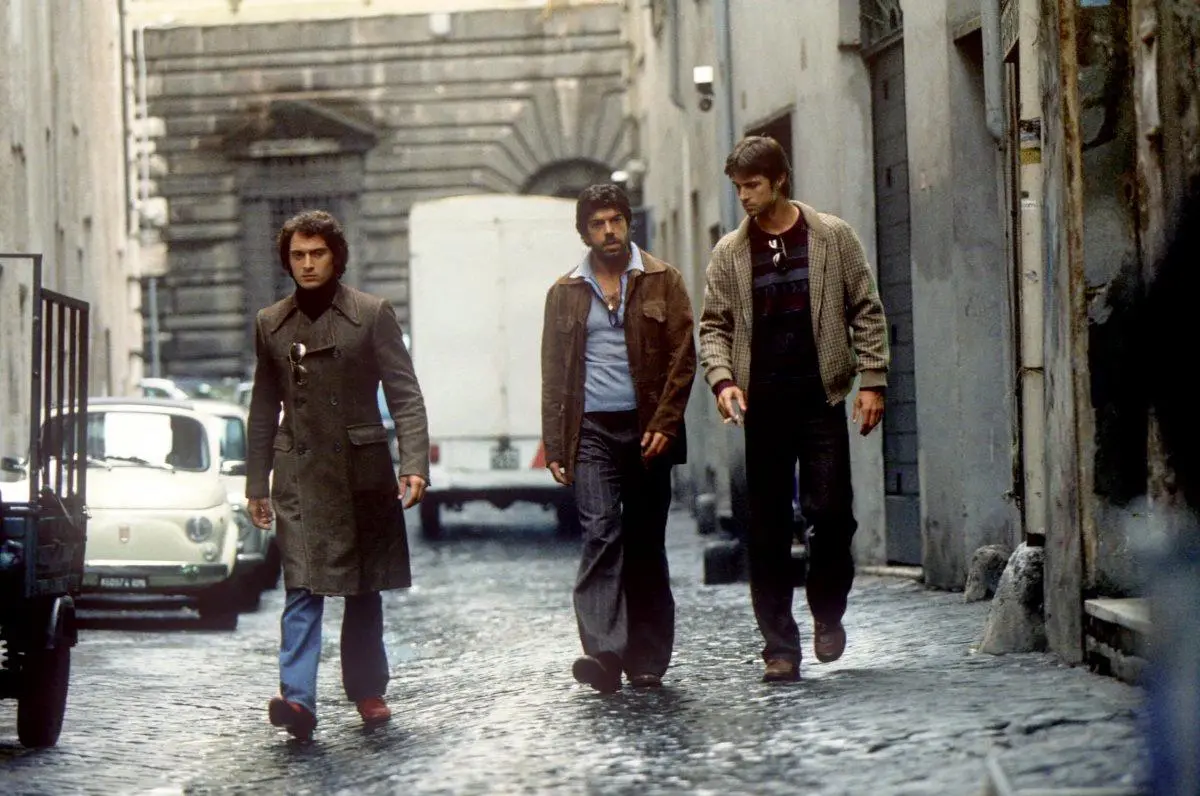
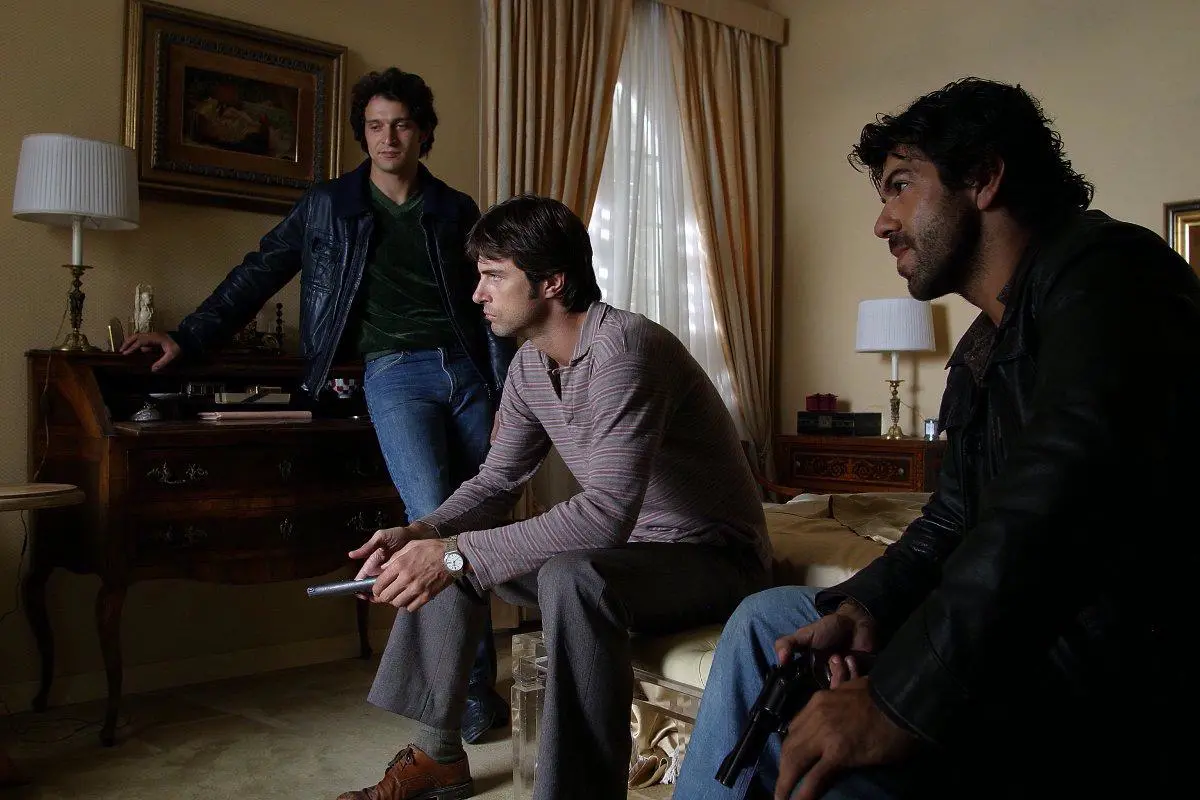
Four kids entertain themselves with daring adventures: during one of these, they steal a car, run over a policeman and escape to their hideout, a caravan on the dunes of Capocotta beach. Later in life, the four form a criminal gang with the aim of conquering Rome. Most of the film was shot in the neighbourhoods of Magliana, Garbatella, Trastevere and Monteverde.
The external façade of Patrizia’s brothel is villino Cirini, in via Ugo Bassi, Monteverde. Freddo’s brother and Roberta live in the same housing estate in Garbatella. The house of Terribile, which later becomes Lebanese’s, is Villa dell’Olgiata 2, in the area of Olgiata north of Rome, while Freddo lives in via Giuseppe Acerbi, in the Ostiense neighbourhood, not far from where Roberta’s car blows up in via del Commercio, in the shadow of the Gazometro.
Terribile is executed on the steps of Trinità dei Monti. Leaning on the rail overlooking the archaeologial ruins in largo Argentina, Lebanese and Carenza talk about the kidnap of Aldo Moro. The Church of Sant’Agostino where Roberta shows Freddo Caravaggio’s Madonna dei Pellegrini is the location for several key scenes in the film. Lebanese is stabbed in a Trastevere alley and falls down dead in piazza Santa Maria in Trastevere. The hunt for Gemito ends in a seafront villa in Marina di Ardea-Tor San Lorenzo, on the city’s southern shoreline, where he is murdered. Forced to hide, Freddo finds refuge in a farmhouse in Vicarello, hamlet of Bracciano. kindergarten curriculum canada
A scene which opens over the altare della Patria and the Fori Imperiali introduces the end of the investigation into Aldo Moro’s kidnap, followed by repertory images of the discovery of his body in via Caetani. The many real events included in the fictional tale include the bomb attack at the station of Bologna at 10:25 am, 2 August 1980: in the film, both Nero and Freddo are in Piazzale delle Medaglie d’Oro several seconds before the bomb explodes.
Commissioner Scaloja, who is investigating the gang, takes a fancy to Patrizia: they stroll near the Odescalchi Castle in Ladispoli. He finds out if his feelings are reciprocated when, several scenes later, he finds her in a state of confusion near Castel Sant’Angelo. To read the Full-Day Kindergarten (FDK) program documents
Four kids entertain themselves with daring adventures: during one of these, they steal a car, run over a policeman and escape to their hideout, a caravan on the dunes of Capocotta beach. Later in life, the four form a criminal gang with the aim of conquering Rome. Most of the film was shot in the neighbourhoods of Magliana, Garbatella, Trastevere and Monteverde.
The external façade of Patrizia’s brothel is villino Cirini, in via Ugo Bassi, Monteverde. Freddo’s brother and Roberta live in the same housing estate in Garbatella. The house of Terribile, which later becomes Lebanese’s, is Villa dell’Olgiata 2, in the area of Olgiata north of Rome, while Freddo lives in via Giuseppe Acerbi, in the Ostiense neighbourhood, not far from where Roberta’s car blows up in via del Commercio, in the shadow of the Gazometro. They are load-bearing pillars
Terribile is executed on the steps of Trinità dei Monti. Leaning on the rail overlooking the archaeologial ruins in largo Argentina, Lebanese and Carenza talk about the kidnap of Aldo Moro. The Church of Sant’Agostino where Roberta shows Freddo Caravaggio’s Madonna dei Pellegrini is the location for several key scenes in the film. Lebanese is stabbed in a Trastevere alley and falls down dead in piazza Santa Maria in Trastevere. The hunt for Gemito ends in a seafront villa in Marina di Ardea-Tor San Lorenzo, on the city’s southern shoreline, where he is murdered. Forced to hide, Freddo finds refuge in a farmhouse in Vicarello, hamlet of Bracciano.
A scene which opens over the altare della Patria and the Fori Imperiali introduces the end of the investigation into Aldo Moro’s kidnap, followed by repertory images of the discovery of his body in via Caetani. The many real events included in the fictional tale include the bomb attack at the station of Bologna at 10:25 am, 2 August 1980: in the film, both Nero and Freddo are in Piazzale delle Medaglie d’Oro several seconds before the bomb explodes.
Commissioner Scaloja, who is investigating the gang, takes a fancy to Patrizia: they stroll near the Odescalchi Castle in Ladispoli. He finds out if his feelings are reciprocated when, several scenes later, he finds her in a state of confusion near Castel Sant’Angelo.
Copyright: Warner Bros
Claudio Santamaria, Pierfrancesco Favino, Kim Rossi Stuart
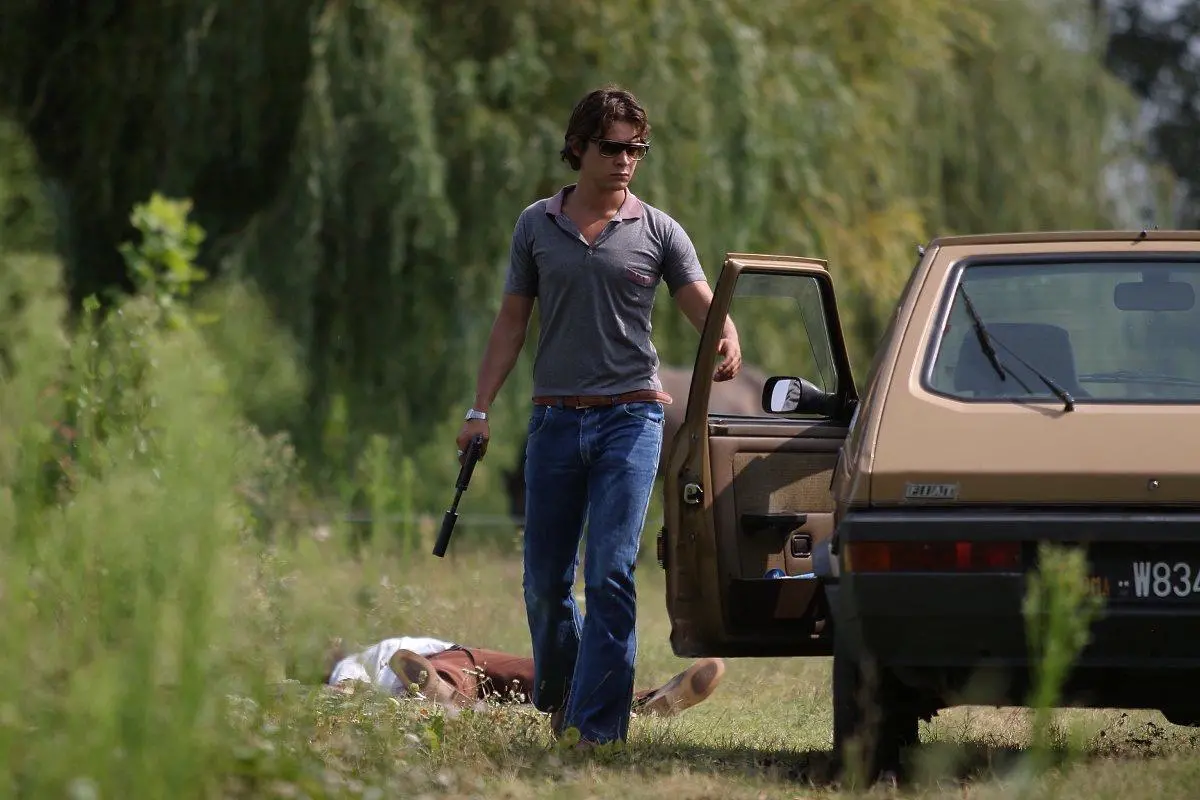
Copyright: Warner Bros
Riccardo Scamarcio
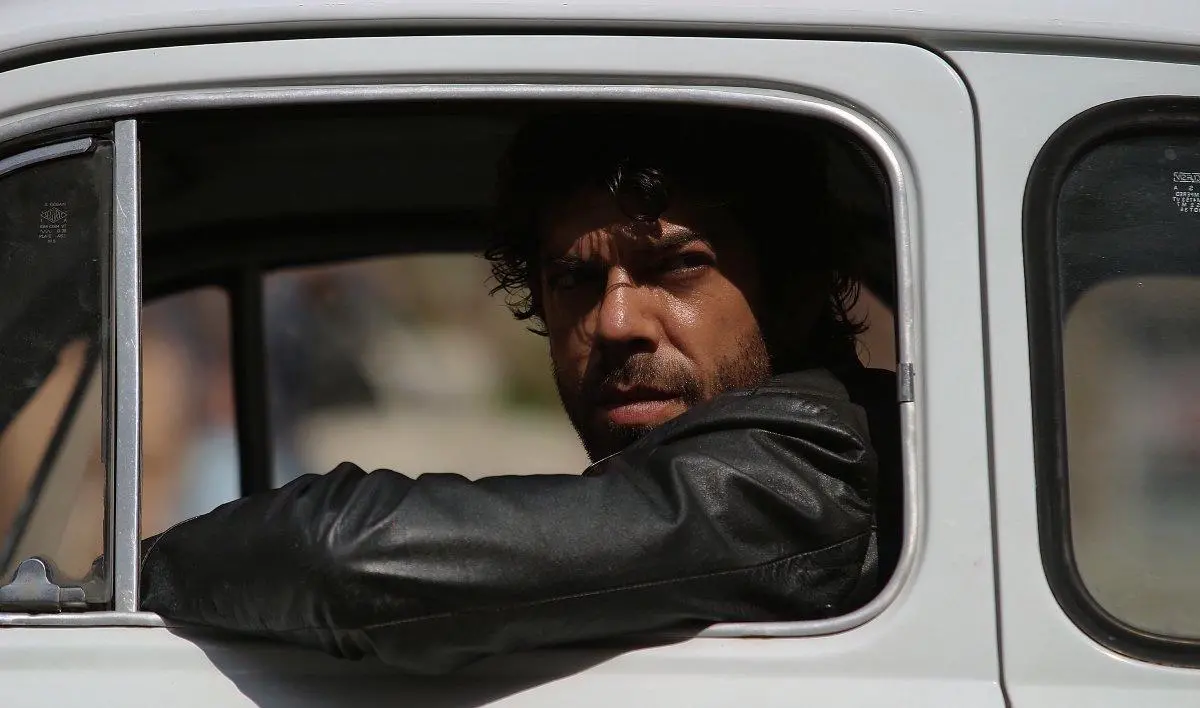
Copyright: Warner Bros
Pierfrancesco Favino
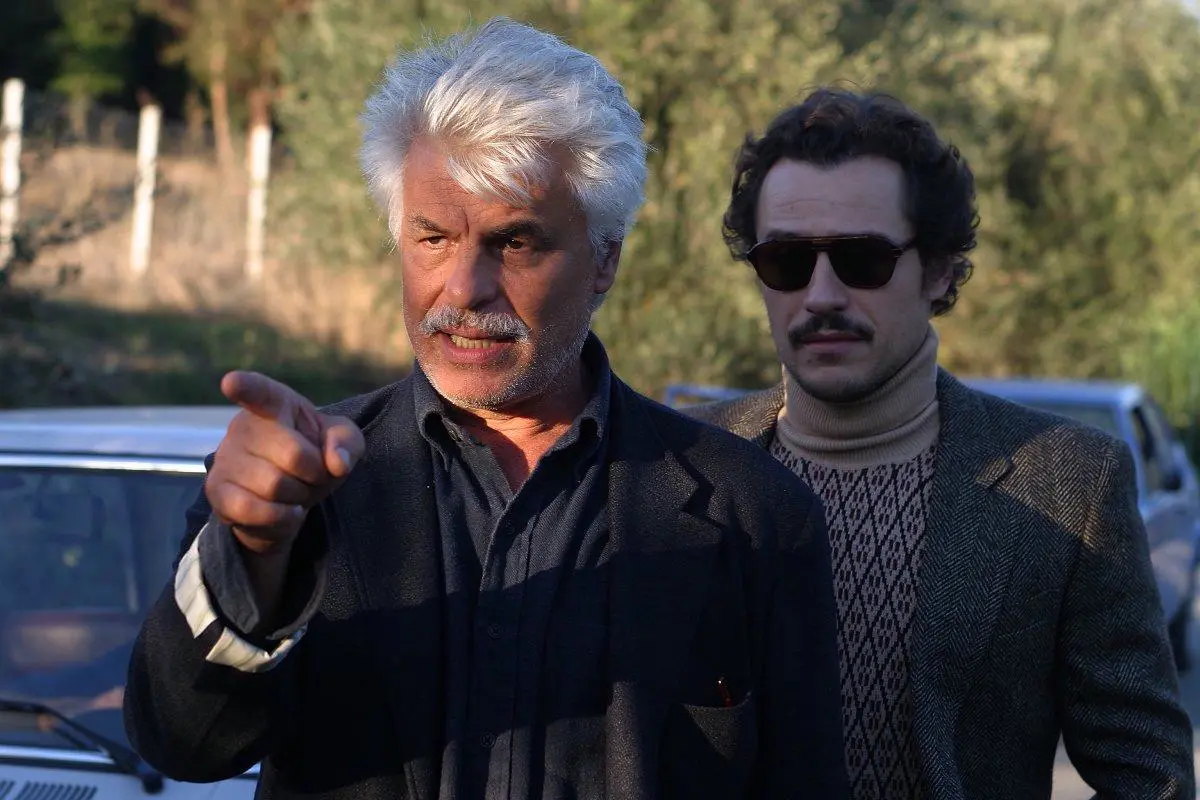
Copyright: Warner Bros
Michele Placido, Stefano Accorsi
Copyright: Warner Bros
Claudio Santamaria, Kim Rossi Stuart, Pierfrancesco Favino
Cattleya, Babe Films, Warner Bros
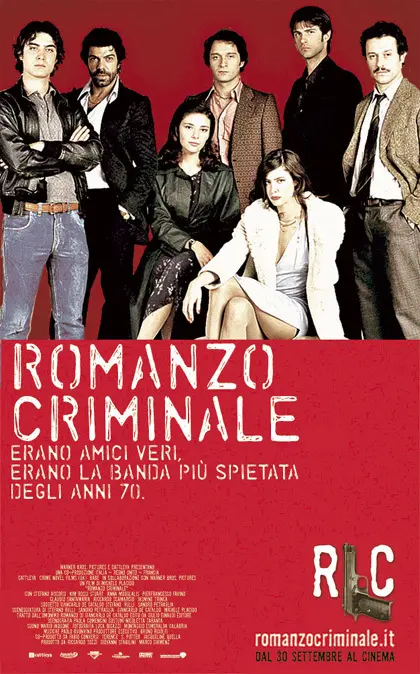
Based on the novel of the same title by Giancarlo De Cataldo. The activities of the “Banda della Magliana” and its successive leaders (Libanese, Freddo, Dandi) unfold over twenty-five years, intertwining inextricably with the dark history of atrocities, terrorism and the strategy of tension in Italy, during the roaring 1980’s and the Clean Hands (Mani Pulite) era.
To read the Full-Day Kindergarten (FDK) program documents is to encounter a philosophical manifesto disguised as a government PDF. The language is deceptively simple: belonging, well-being, engagement, expression. But these four frames are not soft buzzwords. They are load-bearing pillars. They acknowledge that before a child can decode the phonetics of “cat,” they must first decode the geography of their own heart. They must know that their name, spoken in their own accent—whether Mandarin, Cree, Punjabi, or French—is welcome here.
What makes the Canadian kindergarten curriculum profound is not its uniqueness—many Nordic countries do this better. It is its political defiance . In a nation that often defines itself by resource extraction and economic pragmatism, the decision to legislate a play-based, inquiry-driven, holistic early years program is a moral statement. It says: Before we teach you to produce, we will teach you to be. Before we ask for your labour, we will ask for your laughter.
Canada’s kindergarten also carries the weight of a specific, fragile geography: winter. The curriculum mandates outdoor learning, even in -20°C. This is not cruelty; it is a theology of resilience. To zip up a snowsuit independently is a fine motor miracle. To hear the silence of falling snow on a forest path is an acoustic education. The Canadian kindergarten teaches that the land is not a backdrop, but a text. In Indigenous-informed curricula (such as B.C.’s First Peoples Principles of Learning ), this deepens further: learning is holistic, relational, and cyclical. The child learns that they are not separate from the ecosystem, but a part of its grammar.
And yet, there is a shadow here. The curriculum is beautiful on paper; its implementation is a human drama of underfunded classrooms, exhausted Early Childhood Educators (ECEs) paid a fraction of what elementary teachers earn, and the quiet, grinding pressure of parents who ask, “Yes, but when will they read ?” The tension between developmental appropriateness and societal anxiety is the fault line running through every kindergarten classroom. We say we value play. But we test, and we rank, and we quietly mourn that a child who cannot yet hold a pencil is labeled “behind.”
In the vast, sprawling geography of Canada—from the misty rainforests of British Columbia to the rocky shores of Newfoundland—there exists a hidden architecture. It is not built of steel or glass, nor does it appear on any map of pipelines or trade routes. It is built of song, of sand, of patience, and of the profound, radical belief that a five-year-old is not an unfinished adult, but a complete human being.
The Canadian kindergarten curriculum is, at its heart, a quiet rebellion against the cult of acceleration. In an era where other jurisdictions rush to digitize the cradle, to measure literacy rates in preschool, and to treat childhood as a mere training ground for the labour force, Canada’s approach (notably in provinces like Ontario, BC, and Quebec) whispers a different truth: Play is the highest form of research.
Deep in the curriculum document, past the learning outcomes and the assessment checklists, there is a ghost. It is the ghost of Friedrich Froebel, the German pedagogue who invented kindergarten—“children’s garden”—as a place where humans grow like plants: slowly, organically, needing light and dark, rain and rest. The Canadian version of that garden is vast and cold, but it is lovingly tended. It knows that the skills of the 21st century—creativity, collaboration, critical thinking, compassion—cannot be programmed into a tablet. They can only be grown, one block tower, one snow angel, one shared story at a time.
So when you walk past a Canadian kindergarten classroom and hear the roar of chaos, the clatter of blocks, the off-key singing of “O Canada,” do not mistake it for noise. It is the sound of a nation doing something quietly radical: trusting that the smallest citizens know exactly how to build the world. They just need the time, the space, and the permission to begin.
To read the Full-Day Kindergarten (FDK) program documents is to encounter a philosophical manifesto disguised as a government PDF. The language is deceptively simple: belonging, well-being, engagement, expression. But these four frames are not soft buzzwords. They are load-bearing pillars. They acknowledge that before a child can decode the phonetics of “cat,” they must first decode the geography of their own heart. They must know that their name, spoken in their own accent—whether Mandarin, Cree, Punjabi, or French—is welcome here.
What makes the Canadian kindergarten curriculum profound is not its uniqueness—many Nordic countries do this better. It is its political defiance . In a nation that often defines itself by resource extraction and economic pragmatism, the decision to legislate a play-based, inquiry-driven, holistic early years program is a moral statement. It says: Before we teach you to produce, we will teach you to be. Before we ask for your labour, we will ask for your laughter.
Canada’s kindergarten also carries the weight of a specific, fragile geography: winter. The curriculum mandates outdoor learning, even in -20°C. This is not cruelty; it is a theology of resilience. To zip up a snowsuit independently is a fine motor miracle. To hear the silence of falling snow on a forest path is an acoustic education. The Canadian kindergarten teaches that the land is not a backdrop, but a text. In Indigenous-informed curricula (such as B.C.’s First Peoples Principles of Learning ), this deepens further: learning is holistic, relational, and cyclical. The child learns that they are not separate from the ecosystem, but a part of its grammar.
And yet, there is a shadow here. The curriculum is beautiful on paper; its implementation is a human drama of underfunded classrooms, exhausted Early Childhood Educators (ECEs) paid a fraction of what elementary teachers earn, and the quiet, grinding pressure of parents who ask, “Yes, but when will they read ?” The tension between developmental appropriateness and societal anxiety is the fault line running through every kindergarten classroom. We say we value play. But we test, and we rank, and we quietly mourn that a child who cannot yet hold a pencil is labeled “behind.”
In the vast, sprawling geography of Canada—from the misty rainforests of British Columbia to the rocky shores of Newfoundland—there exists a hidden architecture. It is not built of steel or glass, nor does it appear on any map of pipelines or trade routes. It is built of song, of sand, of patience, and of the profound, radical belief that a five-year-old is not an unfinished adult, but a complete human being.
The Canadian kindergarten curriculum is, at its heart, a quiet rebellion against the cult of acceleration. In an era where other jurisdictions rush to digitize the cradle, to measure literacy rates in preschool, and to treat childhood as a mere training ground for the labour force, Canada’s approach (notably in provinces like Ontario, BC, and Quebec) whispers a different truth: Play is the highest form of research.
Deep in the curriculum document, past the learning outcomes and the assessment checklists, there is a ghost. It is the ghost of Friedrich Froebel, the German pedagogue who invented kindergarten—“children’s garden”—as a place where humans grow like plants: slowly, organically, needing light and dark, rain and rest. The Canadian version of that garden is vast and cold, but it is lovingly tended. It knows that the skills of the 21st century—creativity, collaboration, critical thinking, compassion—cannot be programmed into a tablet. They can only be grown, one block tower, one snow angel, one shared story at a time.
So when you walk past a Canadian kindergarten classroom and hear the roar of chaos, the clatter of blocks, the off-key singing of “O Canada,” do not mistake it for noise. It is the sound of a nation doing something quietly radical: trusting that the smallest citizens know exactly how to build the world. They just need the time, the space, and the permission to begin.